

A Mentimeter alternative for what happens after the session
Praxis Live vs Mentimeter
Mentimeter is the better pick if you want polls and quizzes inside PowerPoint, a big event with hundreds or thousands of people, or a free plan to start on.
Praxis Live is the better pick for workshops and training where people should talk to each other, not just to the screen, and where what the room said has to keep working afterward: a report your sponsor can be reading the same afternoon, and follow-up drafted from the room's own answers.
Praxis Live is built by facilitators, for the way facilitators actually run a room.
Checked against Mentimeter’s own site on October 4, 2026. See the sources
Leading Through Change · Day 1
SampleWhat to work on next
The room is ready to name hard things, and stuck on where to start. Pick one priority for the next thirty days and make it the first agenda item every week.
What the room kept coming back to
- Saying the hard thing early14
- Too many priorities at once11
- Feedback only flows down8
- Meetings without decisions5
“We agree in the room and then nobody owns it on Monday.”
Quotes are shown with no names.
After the session. The report your sponsor reads, and the page each person keeps. Sample content.
Side by side
Praxis Live and Mentimeter, row by row.
Every Mentimeter line is from Mentimeter’s own site or help center, checked on October 4, 2026. The small numbers point to the page we read.
| Praxis Live | Mentimeter | |
|---|---|---|
| What participants need | A phone or a computer, whichever is handy. They scan a QR code, type a short code, or open it in a browser tab. No app to download. | A phone or computer with internet. They join with a code at menti.com, a QR code or a link, with nothing to install. Names are a setting you choose.2,3,4 |
| Activity types | The usual ones, like polls, word clouds, Q and A and ranking. Plus icebreakers and team building that are tried and true and built right in, like Classroom 404, Story Relay and Hot Seat. Designed by facilitators, from 30 years of running rooms. | Multiple choice, word cloud, open ended, scales, ranking, 100 points, 2 by 2 grid, Q&A, guess the number and quiz competitions. The free plan includes 23 slide types.5,1 |
| Pairing people by their answers | Find Your Match pairs people who picked the same thing, or deliberately the opposite, and tells both of them why. Small Talks sorts the room into groups by what they think. | Segmentation breaks results down by how people answered another question (paid plans). We didn't find a feature that introduces participants to each other.8 |
| A divided room | Shows the spread, and labels a divided statement “split: the room does not agree on this one.” | A scales question shows the spread of answers as a graph, with the weighted average in a circle.7 |
| The report after the session | Praxis drafts a report from what the room said: what to work on next first, then themes and quotes, no names. You edit and approve it, then share one link. | AI Key insights appear at the top of the Results tab once five or more people answer; you can copy or regenerate them. Share a results link, compare two questions side by side, export to PDF or Excel on paid plans.5,6,1 |
| AI with the room's answers | Summarize puts a few plain lines about what the room wrote on the wall. Built-in AI suggests themes for a wall of answers, and you keep or break them apart with the room watching. AI types up a photo of each table’s flip chart and marks every word it isn’t sure of. | AI Key insights appear on their own once five or more people answer, and AI Grouping sorts open answers once there are ten or more. We didn’t find a way to read a photographed flip chart.5,6 |
| Before and after the session | Praxis Journeys, a second product: short sessions before and after, a quick recall, a journal prompt, a weekly challenge and a cohort conversation, with email reminders. Live drafts two or three weeks of follow-up from what the room said; you edit it and place it in the journey. | Survey mode lets people answer at their own pace, before a session or over days or weeks. Menti Pulse runs a recurring check-in and tracks the trend. Its training guide suggests putting key findings in your follow-up message. Its help center lists a follow-up Menti based on your results as coming soon.9,10,11,16 |
| Facilitation methods | Built-in activities for Nominal Group Technique, Dot Vote, What, So What, Now What, table discussions, a photo of each table’s flip chart on the wall, and Before and After. | Ranking, 100 points and a 2 by 2 grid, Q&A with upvotes and moderation, and a training guide with flows like a before-and-after knowledge check.6,11 |
| Turnkey team building games | A Team building shelf: Classroom 404, Story Relay, Grid Logic, The Bigger Picture and Hot Seat. Make a few choices in the editor, and the room needs nothing but their phones. | Quiz competitions that add up scores and reveal a winner. We didn’t find turnkey team building games like these.14 |
| PowerPoint | Runs on its own screen. Bring in your deck from PowerPoint, Google Slides or Keynote, and the activities go between the slides. It doesn't run inside PowerPoint. | A PowerPoint add-in on every plan, in the PowerPoint desktop app. Paid plans also import PowerPoint, Keynote or PDF files.12,1 |
| Building a session with AI | Tell the built-in AI what you want the room to do and it suggests activities, then drafts the one you pick. One click turns an imported slide into an editable one. To build a whole session from your deck or notes, connect your own Claude or ChatGPT. | An AI assistant in the editor builds a Menti from a description, or from files you upload, including a slide deck it adds interactive slides around. ChatGPT and Claude can also connect to Mentimeter and create Mentis.16,17 |
| If the internet goes down | Praxis Live needs internet too. Backup PowerPoint downloads the session as a deck that needs none: every activity becomes something the room does with hands, pens or voices. | Needs an internet-connected device. Its own checklist suggests keeping a non-interactive version of key slides, such as a PDF export, to fall back to.2,3 |
| Price | 14-day free trial, no card. | A free plan with 50 participants a month. Basic is $14 and Pro $28 per presenter a month, billed yearly; Enterprise is custom. Prices in USD, as shown to us.1 |
Fair is fair
Where Mentimeter is the better choice
Mentimeter is a good tool, and plenty of rooms need exactly what it does. If one of these is you, start there.
You want it inside PowerPoint, or AI that reads your deck
Mentimeter has a PowerPoint add-in on every plan, so the questions sit on your own slides in the PowerPoint desktop app. Its AI assistant can also take an uploaded deck and add interactive slides around it, right in the editor.12,16 Praxis Live runs on its own screen and takes your deck from PowerPoint, Google Slides or Keynote; to build from a deck with AI, you connect your own Claude or ChatGPT.
A town hall or a conference
Paid plans have unlimited participants, and Mentimeter writes guidance for events of hundreds or even thousands of people.1,13 Praxis Live is built for workshops and training rooms.
Quiz night energy
Quiz competitions add up scores across questions and reveal a final winner.14 If the quiz is the point of the session, Mentimeter does it well.
A free plan and a published price
You can start on a free plan with 50 participants a month, and the paid plans have prices on the page.1 Praxis Live has a 14-day free trial and no free plan.
Where Praxis Live is different
The room part will feel familiar. What happens next won’t.
A question on the big screen and answers from phones: if you’ve used Mentimeter, you know that part. Praxis Live is built around what the room does with it, and what happens after everyone goes home.
01
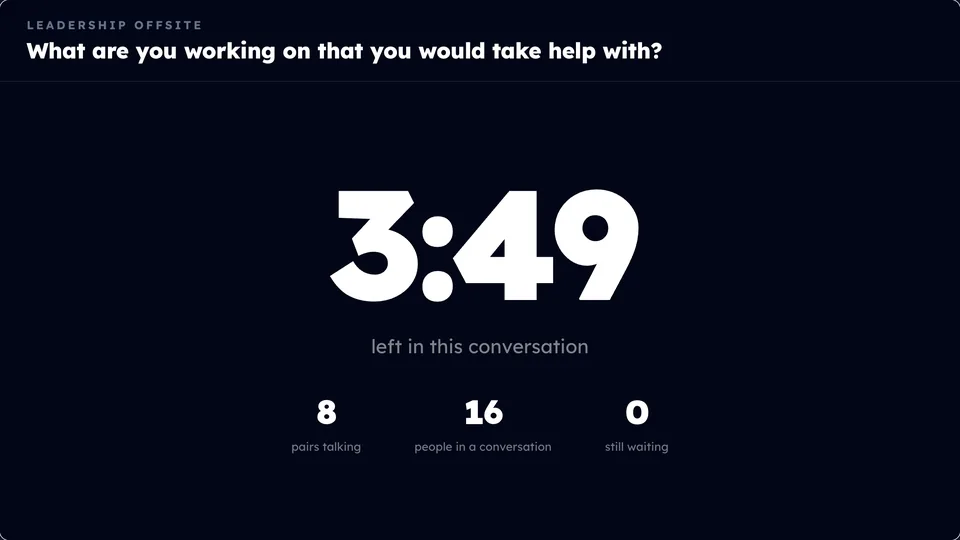
People get introduced to each other by how they answered.
Find Your Match pairs people who picked the same thing, or deliberately somebody who picked the opposite. Both are told who they got and why, quoting what each of them picked. Then they go find each other and talk. A first name goes to one other person, and the phone says so before anyone answers.
Small Talks turns everyone’s answer into a colored badge on their phone, and the room sorts itself by what it thinks.
02
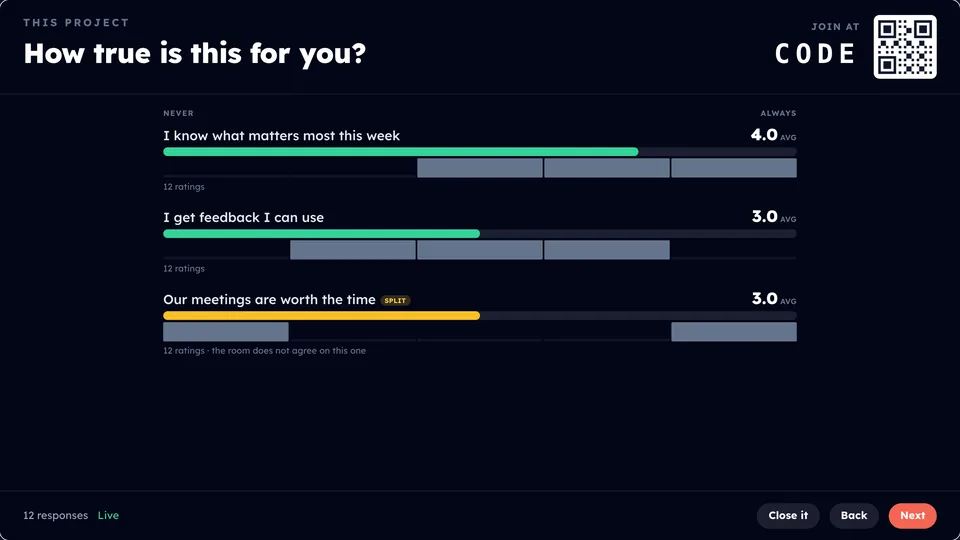
A split room gets called a split.
A room of ones and fives has the same average as a room of threes. One of those is a finding. When a statement divides the room, Praxis Live draws the spread and labels it: the room does not agree on this one.
Now you know where the real conversation is, before you move on.
03
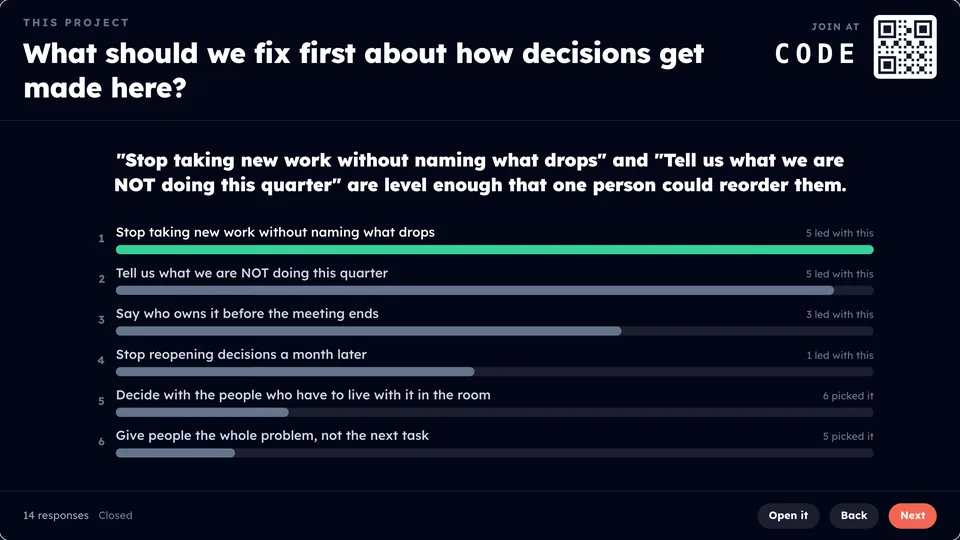
The methods you already run on flip charts, built in.
Nominal Group Technique: everybody writes alone before anybody speaks, then the room ranks. Dot Vote. What, So What, Now What. Table discussions that come back as words on the wall, and a photo of each table’s flip chart, typed up by AI with every unsure word marked. Before and After, which leads with what didn’t move.
Having people write ideas alone before pooling them produces more ideas than open discussion. That is why the nominal group technique exists.Van de Ven and Delbecq (1974), Academy of Management Journal 17(4), 605-621.
04
What the room said keeps working after the room.
When the session ends, Praxis drafts a report from what the room said, like the sample at the top of this page: what to work on next at the top, then the themes and quotes, no names attached. AI helps draft it, and you approve it before it’s shared. Your sponsor can be reading it the same afternoon. Each person also leaves with their own page of what they said, next to where the room landed.
Then Praxis drafts two or three weeks of Monday, Wednesday and Friday follow-up from the room’s own answers. You edit it and place it in a Praxis Journey: sessions under 15 minutes, a quick recall, a journal prompt, a weekly challenge, the cohort talking it through, and an email when each one is ready. Praxis Journeys starts with a call, and isn’t part of the 14-day trial.
Your Monday drop is ready. About ten minutes.
About AI
Both use AI. They point it at different things.
Matched. Both summarize or group what people wrote, build from a prompt, and connect to Claude or ChatGPT. Its AI assistant also reads an uploaded deck and adds interactive slides inside the app, which Praxis Live does only through your own Claude or ChatGPT.5,6,16,17
Different. Praxis drafts the weeks after from the room’s own answers, types up photographed flip charts, and drafts a sponsor report that is shared only after you approve it. We didn’t find those in Mentimeter.
Using both
You don’t have to pick one for everything.
Plenty of organizations already pay for Mentimeter for the all-hands and the conference stage. Keep it there. Use Praxis Live for the working sessions: the leadership offsite, the training day, the room where people need to talk to each other and decide something together.
Praxis Journeys works on its own too, so a program can add the before and the after around any session. The one thing that needs Praxis Live in the room is follow-up drafted from what that room actually said.
Questions buyers ask
Mentimeter or Praxis Live?
- Is Praxis Live a good Mentimeter alternative?
- For workshops and training, yes. The room part works the same way: a question on the big screen, answers from phones. The difference is what the room does with it, like pairing people by how they answered, and what happens after: a report you approve for your sponsor, and follow-up drafted from the room's answers in Praxis Journeys. For quizzes, a free plan or a very large event, Mentimeter may suit you better.
- Does Mentimeter have anything for after the session?
- Yes. Mentimeter has Survey mode for answering at your own pace before or after a session, Menti Pulse for recurring check-ins, a shareable results link, AI Key insights, and PDF or Excel export on paid plans. Praxis plans the weeks after from what your room said: short sessions with a recall, a journal prompt, a challenge and the cohort, and an email when each is ready.
- Does Praxis Live work inside PowerPoint?
- No. Praxis Live runs on its own screen. Bring in your deck from PowerPoint, Google Slides or Keynote, and the activities go between the slides. Mentimeter has a PowerPoint add-in on every plan, for the PowerPoint desktop app.
- How do Praxis Live and Mentimeter compare on AI?
- Closely, on the basics. Both summarize or group what people wrote, build from a prompt, and connect to Claude or ChatGPT. Mentimeter's AI assistant also reads an uploaded deck and adds interactive slides inside the app; Praxis Live does that only through your own Claude or ChatGPT. Praxis points AI at different jobs: drafting the weeks after from the room's own answers, typing up photographed flip charts, and drafting a sponsor report that is shared only after you approve it. Mentimeter's help center lists a follow-up Menti based on results as coming soon.
- Is there a free version?
- Mentimeter has a free plan with 50 participants a month. Praxis Live has a 14-day free trial with no card, and when the trial ends it simply stops.
- Do people need to download an app?
- Not for either one. With Praxis Live, people join in the browser on a phone or a computer: scan a QR code, type a short code, or open it in a tab. Mentimeter works the same way, through menti.com, a QR code or a link.
- What about Beekast, or other tools that cover the follow-up?
- Beekast also covers before and after: it offers self-paced learning journeys with checkpoints, and you can assign action items. Where Praxis differs is that the follow-up is drafted from what your room actually said, people get paired up by how they answered, and the methods facilitators already run, like nominal group technique, are built-in flows.
See it with your own group.
Play a demo right now, no sign-in. Or build a session with your slides and run it for real: free for 14 days, no card, and when the trial ends it simply stops.
Praxis Journeys, the before and after, starts with a call. It isn’t part of the trial.
How we checked
Every Mentimeter fact on this page comes from Mentimeter's own site and help center, read on October 4, 2026. Prices are the ones its pricing page showed us in US dollars. Their plans and features change, so if something here has moved, tell us and we’ll fix it.
- 1.Mentimeter plans and pricing
- 2.Mentimeter help: Requirements for running Mentimeter
- 3.Mentimeter help: Get ready for your in-person Menti
- 4.Mentimeter help: Choosing participant identity settings
- 5.Mentimeter help: AI Key insights for your Menti Live
- 6.Mentimeter help: Making the most of your Mentimeter results
- 7.Mentimeter help: Scales questions
- 8.Mentimeter help: Segmentation of responses
- 9.Mentimeter help: How to run a survey with Mentimeter (Survey mode)
- 10.Mentimeter help: How to use Menti Pulse
- 11.Mentimeter help: How to use Menti in training sessions
- 12.Mentimeter help: Add and present Mentimeter slides in the PowerPoint add-in
- 13.Mentimeter help: Using Mentimeter at large events
- 14.Mentimeter help: How to create a Quiz Competition
- 15.Mentimeter help: Let your audience view the Menti results after participating
- 16.Mentimeter help: Create and edit Mentis with the AI assistant
- 17.Mentimeter help: How to connect ChatGPT or Claude to Mentimeter using MCP