
Skip to content
NewSales kickoffs don’t close deals. Follow-through does. Read the whitepaper ›

Get Your Insight

Be honest: what happens when the workshop ends?

Which statement feels most familiar right now?

(Pick the one that makes you nod, or wince.)

In just 90 seconds, pinpoint what’s missing and what to do about it.

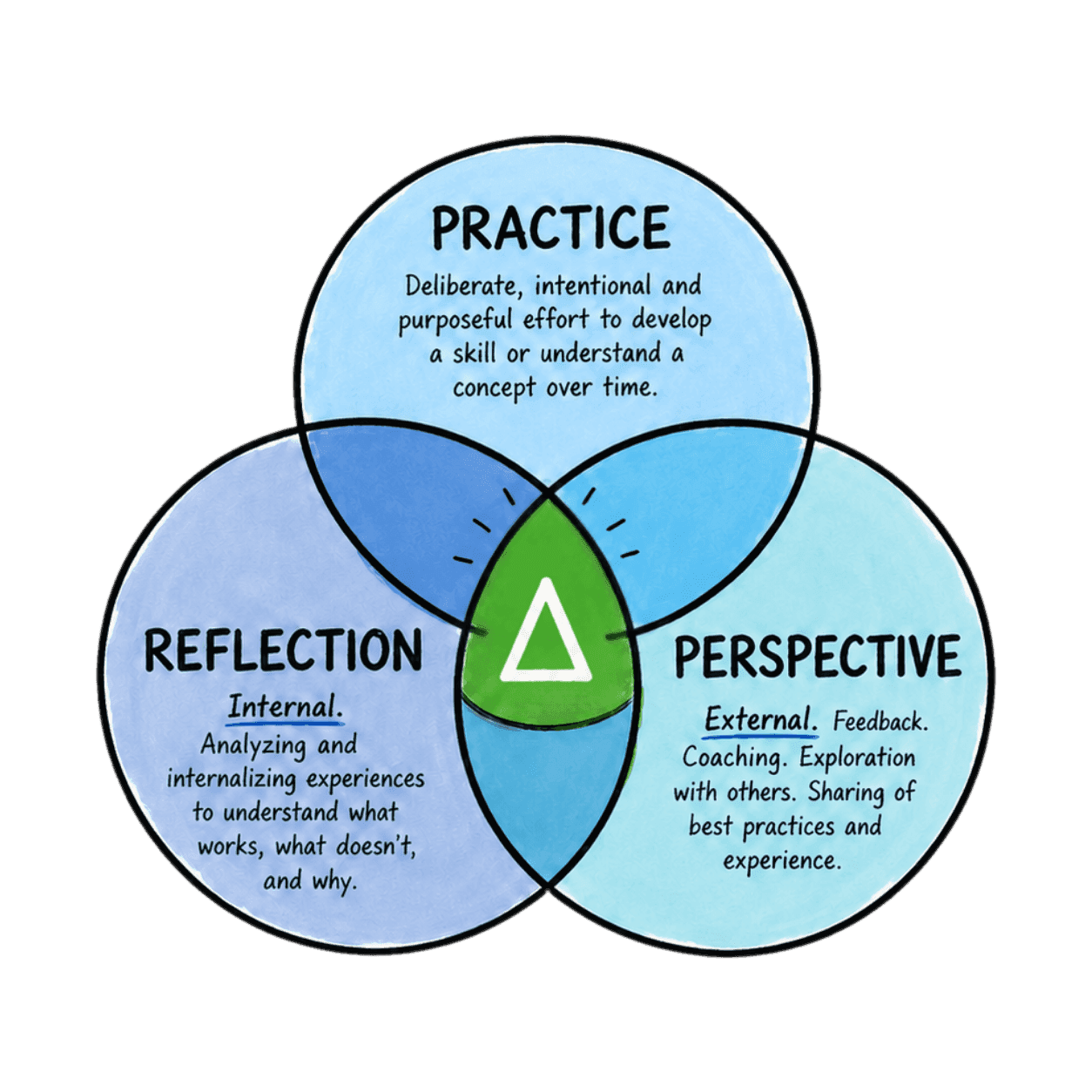
The Delta: three overlapping circles. Practice: deliberate, intentional and purposeful effort to develop a skill or understand a concept over time. Reflection, internal: analyzing and internalizing experiences to understand what works, what doesn't, and why. Perspective, external: feedback, coaching, exploration with others, sharing of best practices and experience. A green delta symbol sits where all three overlap.

The Delta

How Learning Actually Happens

When Learning Sticks

The TruthLearning stickiness happens when deliberate practice, self-reflection, and outside perspective overlap. This is where you stop just "knowing" it and start actually "doing" it.

When you practice, reflect on what happened, and get feedback from others, you don't just get better. You evolve. That's when learning stops being an event you attended and starts being the way you work.

But most of the time, we’re missing a piece of the puzzle:

  • Practice without reflection is just repetition without insight.
  • Reflection without perspective keeps your blind spots blind.
  • Perspective without practice is just a nice conversation.

Growth happens when you have all three.

Continue to Diagnosis ›

Every result, written out

The four results

Training usually fades for one of four reasons: there’s no time to practice, no pause to reflect, no one to get feedback from, or the pieces never connect. Here is each one, with one thing to try this week.

Statement A

The Practice Gap

“Learning stops when the real work starts.”

“We get hyped in the room, but back at our desks, the whirlwind takes over. The ideas made sense, but we never actually find the time to use them.”

Try This Tomorrow

The '30-Minute' Treaty

Don't just say 'go practice.' Ask your group to open their calendars right now and block 30 minutes this week for a 'Practice Lab'. If it's not on the calendar, it's just a wish.

Read the whole result ›

The Reality

The energy in the room was real, but so is the inbox. When training ends without a game plan for 'Monday morning', new skills get crushed by old routines. It's not that people don't want to change. They literally don't have the space to.

Why It Happens

We optimize for speed, not learning. We treat training like a car wash: you go in, you come out clean. But skills are like muscles; they need gym time, not just a lecture.

The Cost

  • The 'sugar crash' after a great workshop
  • Skills rusting before they're used
  • Teams thinking they 'know' it just because they heard it
  • Wasted budget on events that don't change behavior

The Fix

Your team isn't lazy. They're just busy. You can fix this by protecting the practice time just as fiercely as you protected the workshop time.

Statement B

The Reflection Gap

“All effort, no insight.”

“We try new things, but we don't really pause to see if they worked. We're busy doing, not learning, so we eventually just slide back to old habits.”

Try This Tomorrow

The 'Friction' Log

Give them a simple assignment: 'Write down one thing this week that felt harder than it should have.' Review these together. Turning frustration into data is how you start solving problems.

Read the whole result ›

The Reality

Your team is running hard, but they aren't looking at the map. Without pausing to ask 'did that work?', experience just washes over them. They get older, but not necessarily better.

Why It Happens

Reflection feels like a luxury. Who has time to sit and think? But without it, you're just spinning wheels. Real learning happens in the debrief, not the activity.

The Cost

  • Making the same mistake twice (or ten times)
  • Burnout without breakthrough
  • Activity mistaken for progress
  • Growth based on luck, not lessons

The Fix

You don't need a new curriculum. You just need a pause button. Turning experience into insight is one of the best uses of a team's time.

Statement C

The Perspective Gap(The Lonely Road)

“Figuring it out the hard way.”

“Everyone is figuring it out on their own. We're working hard, but without feedback, we make the same mistakes longer than we should.”

Try This Tomorrow

The 'Gut Check' Challenge

Challenge your team to stop flying solo this week. Before they hit send on a big email or lock in a plan, ask them to grab a partner from the workshop. Talk it out. Get an outside perspective. In the next session, debrief on what they learned from that fresh pair of eyes.

Read the whole result ›

The Reality

Your people are learning in silos. They're doing their best, but they're paying the 'tuition' of trial and error individually. They need a shortcut.

Why It Happens

We assume smart people will figure it out. And they will, eventually. But why wait? Feedback is the cheat code for speed, yet we usually treat it as a formal performance review instead of a daily tool.

The Cost

  • Reinventing the wheel constantly
  • Slow, painful improvement
  • Blind spots that stay blind
  • Teams working hard but staying stuck

The Fix

You don't need to be the expert. You just need to connect them to each other. Peer feedback scales faster than your coaching ever will.

Statement D

Fragmented Learning

“The dots aren't connecting.”

“It's hit or miss. Sometimes it clicks, sometimes it doesn't. The training feels like a one-off event rather than a new way of working.”

Try This Tomorrow

The 'Real World' Bridge

Don't let the workshop fade. 48 hours later, send a note: 'Pick one real problem on your desk today. How does [Concept X] help you solve it?' Force the connection between the classroom and the cubicle.

Read the whole result ›

The Reality

You have all the right ingredients, but they're in different cabinets. Training happens here, work happens there, and feedback happens... sometimes. It’s not broken, it’s just scattered.

Why It Happens

We treat learning as an event, not a system. We host the workshop and hope the rest takes care of itself. But without a bridge, the transfer never happens.

The Cost

  • Training feels like 'just another meeting'
  • Good ideas dying on the vine
  • Cynicism that 'nothing ever changes'
  • Inconsistent results across the team

The Fix

You're closer than you think. You don't need new pieces; you just need to glue them together. A few intentional bridges can turn a workshop into a workflow.

Stop ending your programs with hope and a high-five.

No card. When the trial ends, it simply stops.