

A whitepaper for sales enablement leaders
Sales Kickoffs Don't Close Deals. It’s Follow-Through That Fuels Performance.
Why kickoffs lose their impact once reps are back in the field, what that really costs, and how to build the follow-through that protects the investment: before they arrive, while they’re in the room, and after they leave.
By Mike Martin, co-founder of Praxis Learning
Updated
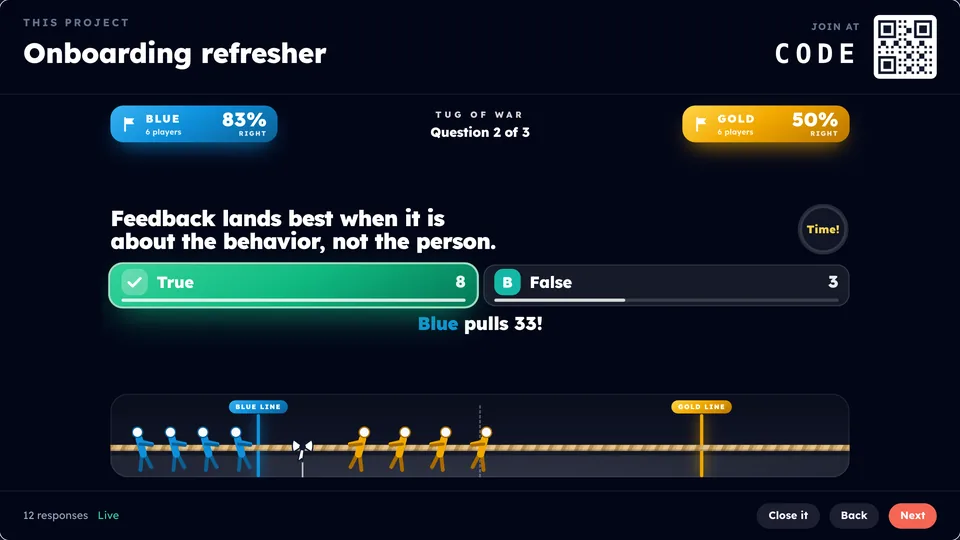
Praxis Live’s Tug of War: recall, played as a team game, in the room.
Sales kickoffs, revenue kickoffs, bootcamps, QBRs, and onboarding events…
These all represent a critical opportunity to align go-to-market teams, energize sellers, and introduce strategic initiatives. They represent a great start to a year, a quarter or a campaign.
Yet, despite their scale and significance, these events run into the same challenge again and again: low post-event engagement, knowledge retention and behavior adoption.
This paper
Looks at why traditional sales events lose their impact, the real consequences of poor pull-through, and a better approach built on spaced practice and social learning to protect and get the most from these investments. Praxis Learning is our example of what that looks like in practice.
The real problem
Why events lose their impact
Sales enablement events are meant to spark lasting change. Memory doesn’t cooperate on its own. Forgetting is steepest soon after we learn something, when nothing brings it back.
And that’s exactly the window most SKO plans leave empty. Reps fly home, the inbox is waiting, and the new talk track has to compete with the old one, which is already loaded.
The usual plan
Everything on the big day, then back to the field
With follow-through
The same kickoff, then short sessions a few times a week
The research on what helps is solid:
What the research says
Spreading review over weeks builds more durable memory than one session.
None of these studies looked at Praxis. Praxis is built around well-established learning principles.
Why this matters
- Messaging gets lost in translation.
- Poor retention means strategy rollouts lose steam.
- Best practices remain theoretical instead of habitual.
- Time and energy invested by sales leaders, presenters, and facilitators go to waste.
- The cost of a forgotten SKO isn't just educational. It's operational and financial.
The high cost of sales kickoffs: a strategic investment at risk
Your SKO investment starts depreciating the moment people leave the room.
Sales kickoff events are pivotal in aligning sales teams, introducing new strategies, and setting the tone for the fiscal year. However, they come with significant financial and resource commitments. You know yours better than any industry average does, so put your own numbers in.
We filled in 100 people and 3 days as a starting point. Count every day away from the field, the event and the travel. Change them to yours, and add what the event costs you per person: travel, rooms, venue, food, speakers, production. Your numbers stay in your browser.
The event’s total investment
Add your cost per attendee
People at the event, times what each one costs you.
Selling days pulled from the field
300
That's about 60 five-day work weeks of selling time.
Each square is one work week of selling time spent at the event instead of in front of buyers.
And that’s before the rest of it
Planning and coordination
Months of effort across enablement, events, executive teams, and vendors, before anyone boards a plane.
Post-event support
Companies often lack the infrastructure or headcount to reinforce what was shared at the SKO, so much of it is left to chance.
Without follow-through, much of this investment is at risk. The true cost of an SKO isn’t just the money. It’s the lost opportunity if it doesn’t stick.
Why traditional approaches fall short
Most companies try to reinforce an SKO in one of three ways.
- 1
Follow-up emails
Typically passive, ignored, or deprioritized. They offer no way to check understanding or encourage action.
- 2
Manager check-ins or accountability partners
These rely on already-overstretched managers to own reinforcement. Without formal structure or visibility, consistency is rare.
- 3
LMS courses or recordings
These are often treated as content archives rather than active tools for reinforcement. They are typically long, disengaging, and lack a behavioral focus.
These approaches miss the core challenge of making learning stick. They’re content-focused, not behavior-focused.
And in sales, behavior is everything.
A better way
Spaced, social, and strategic learning reinforcement
Learning research points to a more effective set of strategies, ones that help people keep what they learned and use it in the real world.
Spaced repetition
Come back to it, again and again, over weeks.
Instead of one-and-done information dumps, return to the content repeatedly over time. Spreading review over weeks builds more durable memory than one session. For an SKO, that means the new messaging, product information and objection handling come back in the weeks after, until they’re second nature.
Recall, not rereading
Recalling what you learned beats rereading it. A quick question on the new talk track does more than another look at the slides.
Social learning
Humans are social learners. Giving reps the chance to reflect on the content, share how they read it, and see how peers are applying it encourages deeper engagement and accountability. In sales teams, peers modeling what works can spread best practices fast.
Support from peers and supervisors after training is linked to new skills getting used, and peer support carried the most weight. Hughes, Zajac, Woods and Salas, 2020
Microlearning
Bite-sized lessons let people take information in manageable chunks. That matters in sales, where reps are juggling a full pipeline and have little time to spare. A short challenge or scenario, a few times a week, fits a rep’s day in a way a long eLearning module rarely does.
Gamification
Points, streaks and a little friendly competition can give people a reason to come back over a longer stretch of practice, and a sense of progress can keep them contributing. Use it as the spark, not the point: the goal is the behavior, not the score.
None of these principles is new. It’s time they shaped how organizations reinforce sales training, especially in the high-stakes weeks after a big event.
The Praxis Learning approach
Habitual learning beyond the SKO, QBR or sales training event
We kept seeing the same pattern, again and again: strong, inspiring learning experiences followed by weak pull-through, retention and practice. Praxis Learning helps training stick: what people do before they arrive, while they’re in the room, and after they leave.
Sticky
Short sessions a few times a week bring the key ideas back, spaced out, so reps recall them instead of rereading them.
Social
Reps work with their peers: trying the new approach, saying how it landed, and hearing what worked for someone else.
Structured
Sessions arrive on a schedule you choose, so the learning lands in small pieces instead of one long sitting.
Simple
Easy to set up, and even easier to use. In the room, people join from their own phone by QR or code. No app to download.
Praxis turns a kickoff into a journey with three stages: Prime, Participate and Practice.
Prime · Before they arrive · Praxis Journeys
Reps land ready.
Two weeks out, every rep gets a short Praxis journey: the new messaging in a couple of minutes, and a few questions to try before they arrive, like the toughest objection they heard last quarter. Getting an answer wrong now is fine. It primes them for the moment it comes up on stage.
Facilitators read the answers before the event, so the first morning starts where the reps actually are.
What the research says
Trying to answer a few questions before a session, even getting them wrong, helps people learn those points when they come up.
Illustration. Your drops, your words.
Participate · While they’re in the room · Praxis Live
Every breakout answers, not just the loudest rep.
The general session is still yours. Praxis Live goes to work in the breakouts, where reps actually practice. You run your slides, and the breakout answers on their own phones, joining by QR or code. No app to download.
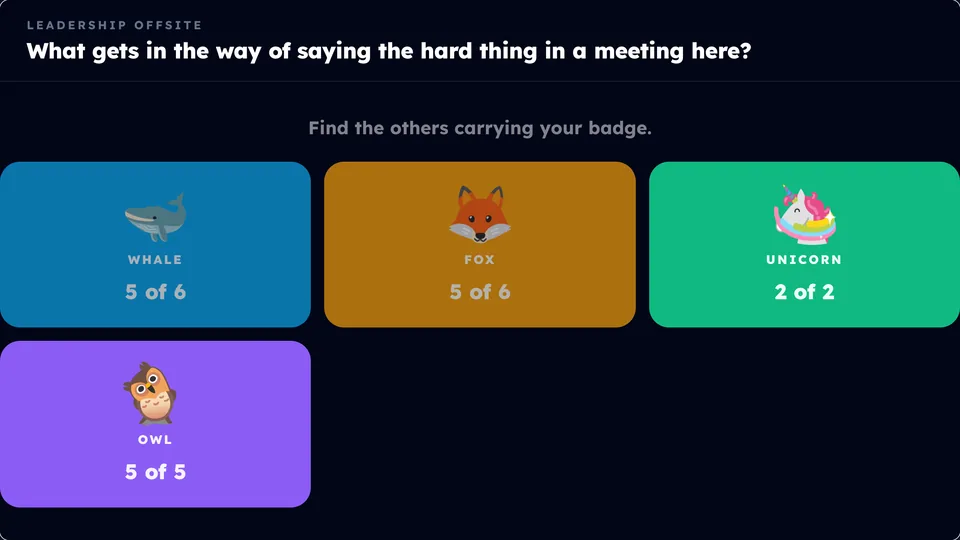
Small Talks sorts reps by how they answered
Everyone answers a question, like “Where do your deals stall?”, and their phone lights up with a color and an animal for their answer. Reps find the others showing the same one and talk it through: the procurement crowd with the procurement crowd.
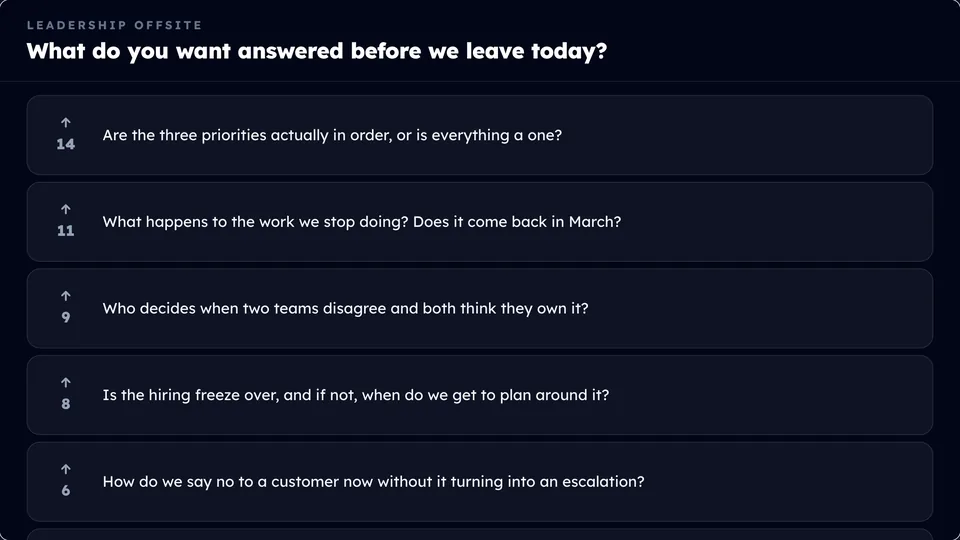
Q and A puts the room’s real questions first
Reps ask what they actually want answered and vote on each other’s questions from their phones. The ones with the most votes rise to the top, so you answer those first.
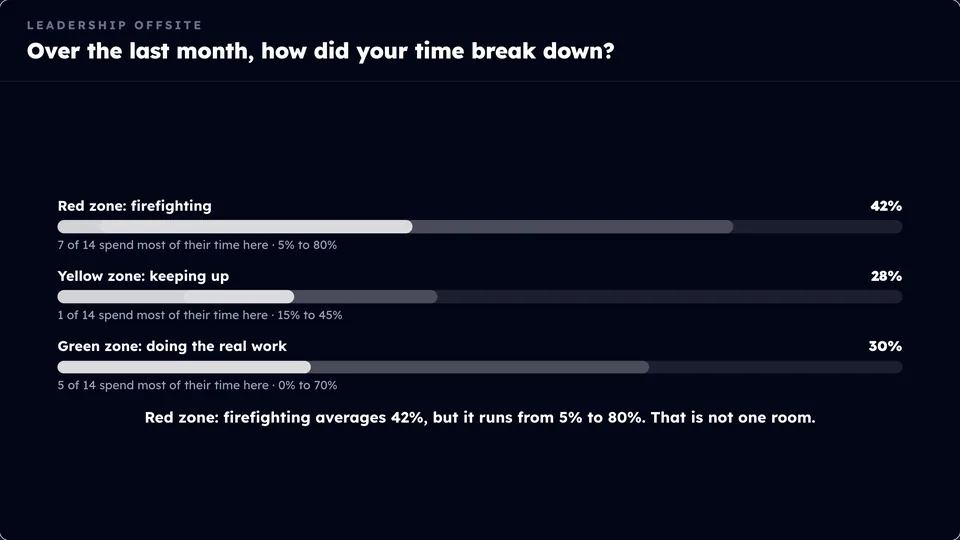
A split room is called a split
When half the room is ready and half isn’t, Praxis Live says so, on the wall and in the report, instead of averaging it into a number that describes nobody.
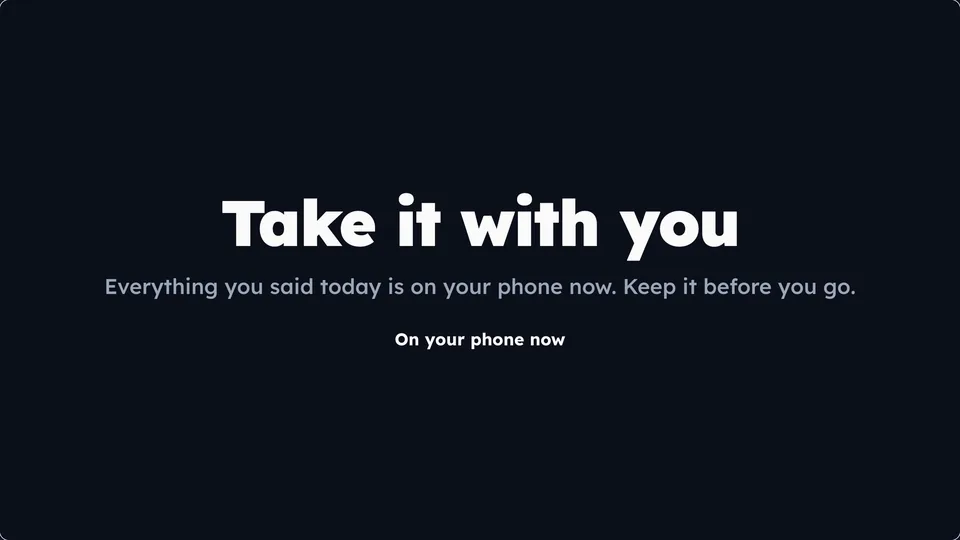
Every rep takes their own page home
Each rep leaves with a page of what they said and committed to, next to what the room said. Including the plan in their own words: “When the buyer says it’s too expensive, I’ll ask…”
Watch them run
Small Talks
Q and A
Tug of War
Take it with you
The sponsor report
What the room said, in the sponsor’s hands the same afternoon.
When a breakout ends, Praxis drafts a report from the room’s answers: what to work on next at the top, then the themes and quotes underneath, with no names attached.
The facilitator edits it and approves it. Nothing goes out before that. Then one link goes to the sponsor, who can be reading it the same afternoon, while the event is still fresh enough to act on.
Sales kickoff · Enterprise breakout
SampleWhat to work on next
Reps are sold on leading with the buyer’s problem, and split on whether they can do it on a first call. Spend the first two weeks of practice on the opening question.
What the room kept coming back to
- Discovery questions still feel scripted9
- Late deals stall in procurement7
- Not sure how to position the new line5
- Want to hear it work on a real call4
Where the room split
Ready to open a first call with the new discovery question?
Reported as a split, not averaged into the middle.
“I get the framework. I just haven’t heard it work on a real call yet.”
Quotes are shown with no names.
Put together from the room’s answers, then reviewed and approved by the facilitator before it was shared.
Practice · After they leave · Praxis Journeys
The SKO follows them into the field.
The Monday after, Praxis Journeys picks up. Short sessions, under fifteen minutes, a few times a week: a quick recall on the new talk track, one thing to try on a real call with when and where they’ll try it, and a conversation with the rest of their cohort about how it went.
You don’t start from a blank page. Praxis Live drafts two or three weeks of Monday, Wednesday and Friday sessions, worded from what the room actually said. You edit them and place them in the journey. An email lets each rep know when the next one is ready, and reps sign in on the web, on a phone or at a desk.
Praxis Journeys starts with a call, so we can plan the weeks with you.
What the research says
Specific “when X happens, I will do Y” plans improve follow-through.
Your Monday drop is ready. About ten minutes.
Illustration. Drafted from what the room said, edited by you.
Guiding principles for sales enablement professionals
To get the most from major sales events, enablement leaders must:
- 1
Design for transfer, not just inspiration
It's not enough to entertain and energize. Events must be built with behavior change in mind, from interactive workshops to practice that runs for weeks afterward.
- 2
Extend learning into the flow of work
Enablement must live where sales happens. Reps should revisit and apply what they learned in their day-to-day work, not in a separate world from it.
- 3
Make reinforcement interactive and collaborative
Sales is social. The best learning happens when peers share, challenge, and model behaviors for one another.
What the research says
Support from peers and supervisors after training is linked to new skills getting used, and peer support carried the most weight.
- 4
Track application, not just attendance
Measuring who showed up isn't enough. Track outcomes: calls made with the new messaging, real pipeline shifts, and qualitative feedback from managers.
Where Praxis fits: it gives you the words. What each breakout said on the day, and what reps write in the weeks after. Call and pipeline numbers stay in your CRM, so put the two side by side.
It’s Not the Event. It’s What Happens After.
No matter how exciting your SKO, its success depends on what your sales team does differently because of it.
Without reinforcement, behavior change is left to chance. With Praxis, you turn inspiration and momentum into motion.
Praxis bridges the gap between knowing and doing by building short practice into the natural rhythm of work. It gives your investment in the event a real chance to show up in the field.
Don’t let your next big enablement moment fade. Equip your team to make learning stick, and perform.
What the research says
Training professionals reported that what happens before and after training is more strongly tied to on-the-job use than what happens during it.
Let’s turn learning into action, together.
For a demo and a deeper dive into the Praxis approach, or a reinforcement plan built around your next SKO:
Or reach out to mike@praxislearning.com
About Mike Martin
Mike is co-founder of Praxis Learning, with 30 years in learning, including Chief Learning Officer at Litmos. Praxis Learning helps training stick: what people do before they arrive, while they’re in the room, and after they leave.
The research behind this paper
- Cepeda et al. (2006). Psychological Bulletin, 132(3), 354-380. Cepeda et al. (2008). Psychological Science, 19(11), 1095-1102. doi.org/10.1037/0033-2909.132.3.354 doi.org/10.1111/j.1467-9280.2008.02209.x
- Rowland (2014). Psychological Bulletin, 140(6), 1432-1463. doi.org/10.1037/a0037559
- Richland, Kornell and Kao (2009). Journal of Experimental Psychology: Applied, 15(3), 243-257. doi.org/10.1037/a0016496
- Gollwitzer and Sheeran (2006). Advances in Experimental Social Psychology, 38, 69-119. doi.org/10.1016/S0065-2601(06)38002-1
- Hughes, Zajac, Woods and Salas (2020). Human Factors, 62(1), 166-183. doi.org/10.1177/0018720819845988
- Saks and Belcourt (2006). Human Resource Management, 45(4), 629-648. doi.org/10.1002/hrm.20135
None of these studies looked at Praxis. The product examples use made-up content, never a client’s.