Skip to content
NewSales kickoffs don’t close deals. Follow-through does. Read the whitepaper ›

How it works

Before, during and after.

The event is where you spend the money. The weeks around it are where you get it back.

When people show up ready and keep practicing after, more of what you paid for shows up in how they work. Most programs only plan the middle. Praxis gives you a plan and a tool for all three.

What the research says

Training professionals reported that what happens before and after training is more strongly tied to on-the-job use than what happens during it.

Saks and Belcourt, 2006

Leading Through Change, drawn to scale

A two-day offsite for 24 managers

The room is two days. Most of the program happens around it, and that’s the part most plans leave out.

One program, start to finish

Walk through “Leading Through Change.”

A two-day offsite for 24 managers, from a week or two before to three weeks after. At each stop: what the managers do, what you do as the facilitator or program owner, and what you get. Tap a stop.

1-2 weeks before · Prime

What are you doing before they get there?

Before they arrive · Praxis Journeys

Give people a few short sessions before the program, so they walk in warmed up, already thinking, and knowing why they're there.

They
Sign in to the journey and get a short drop or two. They meet the other 23 managers, read one short framing piece, and answer one question to sit with: what's a change you're leading right now that people are pushing back on?
You
Set up the drops and invite the cohort. Then read what they're walking in with before you plan your opening. If half the room names the same sticking point, you know where day one starts.
You get
Shared language, surfaced expectations, and people who show up ready instead of cold.

What the research says

Trying to answer a few questions before a session, even getting them wrong, helps people learn those points when they come up.

Richland, Kornell and Kao, 2009

Your first drop is ready. About eight minutes.Email
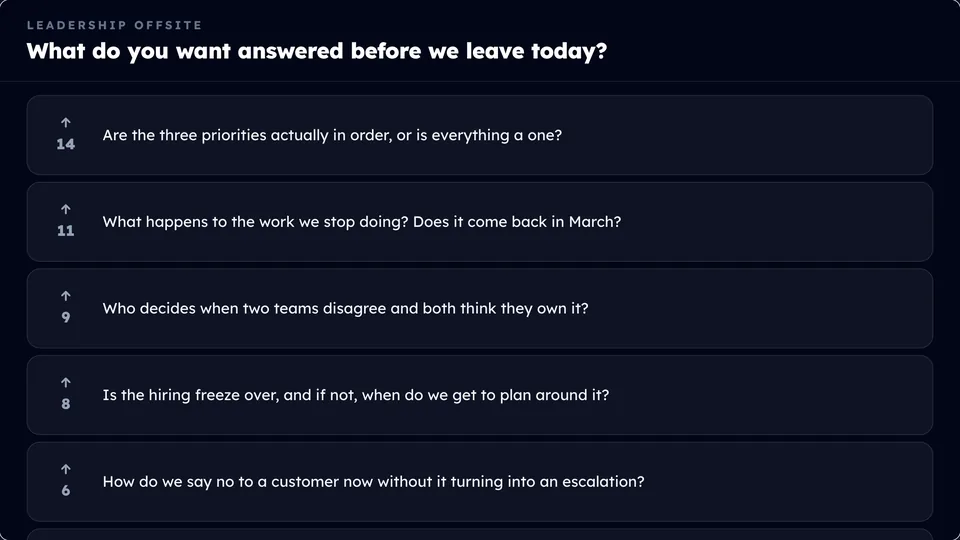
Illustration of a Prime drop in Praxis Journeys.

Day one · Participate

While they're there?

While they're in the room · Praxis Live

Give everyone a way in. Each person answers on their own phone, and the whole room's answer goes up on the big screen for everyone to talk about.

They
Scan the code on the screen and answer on the phone already in their hand. No app to download. Their questions for the two days go up on the wall, and the room votes the ones that matter most to the top. After lunch, Small Talks turns each phone into a badge, and people get up and find the others who answered the same way.
You
Bring your own deck and run your slides and the activities from one screen. Watch the answers come in, then talk about what the room actually said, not what you guessed it would say.
You get
Every answer saved as it comes in, and a room that's in it with you, not just the three people who always talk.

What the research says

People learn more doing than listening. (The strongest evidence is from college science courses.)

Freeman et al., 2014

Praxis Live on the big screen at a leadership offsite: the room's questions, ranked by votes
Praxis Live: the room’s questions on the wall, voted to the top from their phones.

Day two · Participate

Before they leave the room?

While they're in the room · Praxis Live

End with decisions and commitments, not applause: the room agrees on what matters, and each person names one thing they'll do, in their own words.

They
Write ideas alone, then read them out and rank them together, so a quiet manager's idea counts as much as a loud one's. Rate themselves again on the skills from day one's opening, and write down the one thing they'll try first. Then leave with their own page of everything they said, next to how the room answered, and a reminder for a week out in their calendar if they want one.
You
Open the report Praxis drafts from the room's answers: what to work on next at the top, the themes and quotes underneath, no names attached. Change what you want and approve it. Nothing goes to the sponsor until you do.
You get
A sponsor who can be reading what the room said the same afternoon.

What the research says

Having people write ideas alone before pooling them produces more ideas than open discussion. That is why the nominal group technique exists.

Van de Ven and Delbecq, 1974

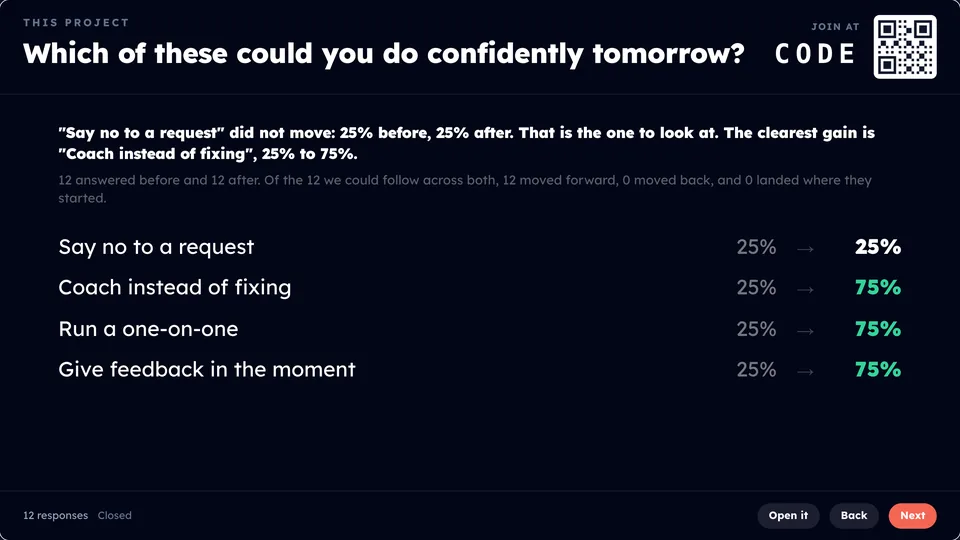
Praxis Live's Before and After on the big screen: how many people could do each skill confidently, at the start and at the end

Sponsor report · Draft

Waiting for you

What to work on next: pick one priority for the next thirty days.

EditApprove and share
The room’s Before and After on the wall, and the report that waits for your approval.

The Monday after · Practice

After they leave?

After they leave · Praxis Journeys

Keep it going with short sessions, a few times a week, under fifteen minutes each. That's what turns what they learned into what they actually do.

They
Get an email that Monday's drop is ready. About ten minutes: a quick recall of what the room said on day one, and one thing to try this week, with when and where they'll try it.
You
Plan the weeks from the session. Praxis Live drafts two or three weeks of Monday, Wednesday and Friday drops, worded from what your room said. You edit them and place them in the journey.
You get
Follow-up written in your room's own words, not a generic course.

What the research says

Recalling what you learned beats rereading it.

Rowland, 2014

What the research says

Specific “when X happens, I will do Y” plans improve follow-through.

Gollwitzer and Sheeran, 2006

Your Monday drop is ready. About ten minutes.Email

Illustration. Drafted from what your room said, edited by you.

Week three · Practice

Three weeks later, is anyone still at it?

After they leave · Praxis Journeys

This is the part most programs never plan. The cohort is still trying things, telling each other how it went, and answering the room's questions again.

They
Post what they tried on Friday's Wall of Wins and name a cohort-mate they saw do something well. Write a journal entry about what's changed. Answer a question from the room again, now in the journey.
You
Read what the cohort is saying, and step in where it's gone quiet. A question you asked in the room keeps collecting answers for weeks.
You get
A program that keeps going after the room goes home.

What the research says

Spreading review over weeks builds more durable memory than one session.

Cepeda et al., 2006 and 2008

What the research says

Support from peers and supervisors after training is linked to new skills getting used, and peer support carried the most weight.

Hughes, Zajac, Woods and Salas, 2020

Still collecting · answers

“Which of these could you do confidently tomorrow?”

  • In the room, day two

    24
  • In the journey, week three

    19

The same activity from the room, set into the journey, keeps collecting answers for weeks.

Illustration of week three in Praxis Journeys.

Praxis Live and Praxis Journeys

Use one, or both together.

Praxis Live is for the room. Praxis Journeys is for the weeks before and after. Each works on its own, and together they connect in two ways.

Prime

Praxis Journeys

  • Short drops before day one
  • Meet the cohort
  • One question to sit with

Learners sign in

then

Participate

Praxis Live

  • Your slides and the activities on one screen
  • The room answers on their phones
  • The report you approve

No app to download

1

The same activities keep going

An activity from the room can go into the journey and keep collecting answers for weeks.

2

Plan the weeks from the session

Praxis Live drafts the follow-up drops from what the room said. You edit them and place them in the journey.

Practice

Praxis Journeys

  • A few short sessions a week
  • Recall, a journal prompt, one thing to try
  • The cohort talking it through

An email when each one is ready

Each works on its own.

Start with one room if that’s what you need. Add the before and the after when you’re ready.

You decide what goes from one to the other.

People join the room from their phone, with no app to download. In the journey, they sign in. Nothing moves between the two unless you put it there.

What this is built on

Built on what the research says about learning that sticks.

Here are the learning principles Praxis is designed around, with how strong each finding is and where it was studied, so you can judge it yourself.

These studies weren’t about Praxis. They’re the research our design follows.

Why plan all three

Training professionals reported that what happens before and after training is more strongly tied to on-the-job use than what happens during it.

Suggestive

Training professionals' estimates, 150 organizations

Saks and Belcourt (2006). Human Resource Management, 45(4), 629-648. doi.org/10.1002/hrm.20135

For leadership programs

In leadership training, spaced sessions, practice and feedback are linked to stronger results.

Strong

335 samples of leadership training

Lacerenza, Reyes, Marlow, Joseph and Salas (2017). Journal of Applied Psychology, 102(12), 1686-1718. doi.org/10.1037/apl0000241

  • PrimeTrying to answer a few questions before a session, even getting them wrong, helps people learn those points when they come up.Lab and classroom studies, mostly students · Richland, Kornell and Kao, 2009Moderate
  • PrimePeople who arrive motivated to learn tend to learn and apply more.Twenty years of workplace training studies · Colquitt, LePine and Noe, 2000Strong
  • ParticipatePeople learn more doing than listening.College science courses · Freeman et al., 2014Strong in classrooms
  • ParticipateHaving people write ideas alone before pooling them produces more ideas than open discussion. That is why the nominal group technique exists.Groups generating ideas · Van de Ven and Delbecq, 1974Strong
  • PracticeSpreading review over weeks builds more durable memory than one session.Large reviews of memory studies · Cepeda et al., 2006 and 2008Strong
  • PracticeRecalling what you learned beats rereading it.Studies of testing versus rereading · Rowland, 2014Strong
  • PracticeSpecific “when X happens, I will do Y” plans improve follow-through.Goals in general; suggestive for training · Gollwitzer and Sheeran, 2006Strong for goals
  • PracticeSupport from peers and supervisors after training is linked to new skills getting used, and peer support carried the most weight.A review of studies on support after training · Hughes, Zajac, Woods and Salas, 2020Strong
Full references